FUEL
It burns a gas
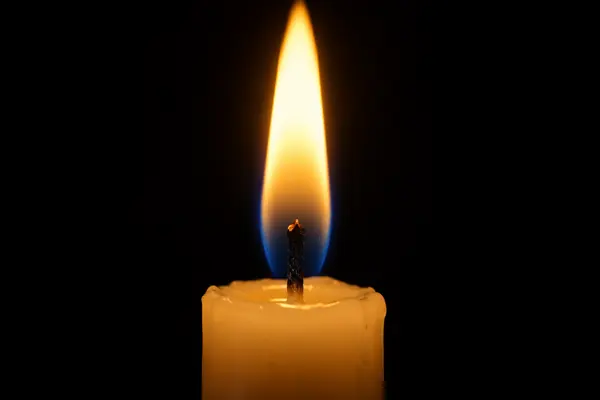
Heat from the flame melts a pool of wax. Capillary action draws it up the wick, where it turns to vapour and burns.
Try Faraday's tests doodleflame
THE SCIENCE OF A CANDLE
A candle does not burn wax. It burns wax vapour.
Explore the flame
≈ 1,400 °Cat the outer edge
Heat melts the wax, the wick lifts it, and the flame turns it into gas that meets the air. Michael Faraday built six famous lectures around that idea at the Royal Institution in 1860–61.
Updated
THE SHORT ANSWER
A candle is a small fuel factory.
Each part of the flame has a job.
FUEL
Heat from the flame melts a pool of wax. Capillary action draws it up the wick, where it turns to vapour and burns.
Try Faraday's testsCOLOUR
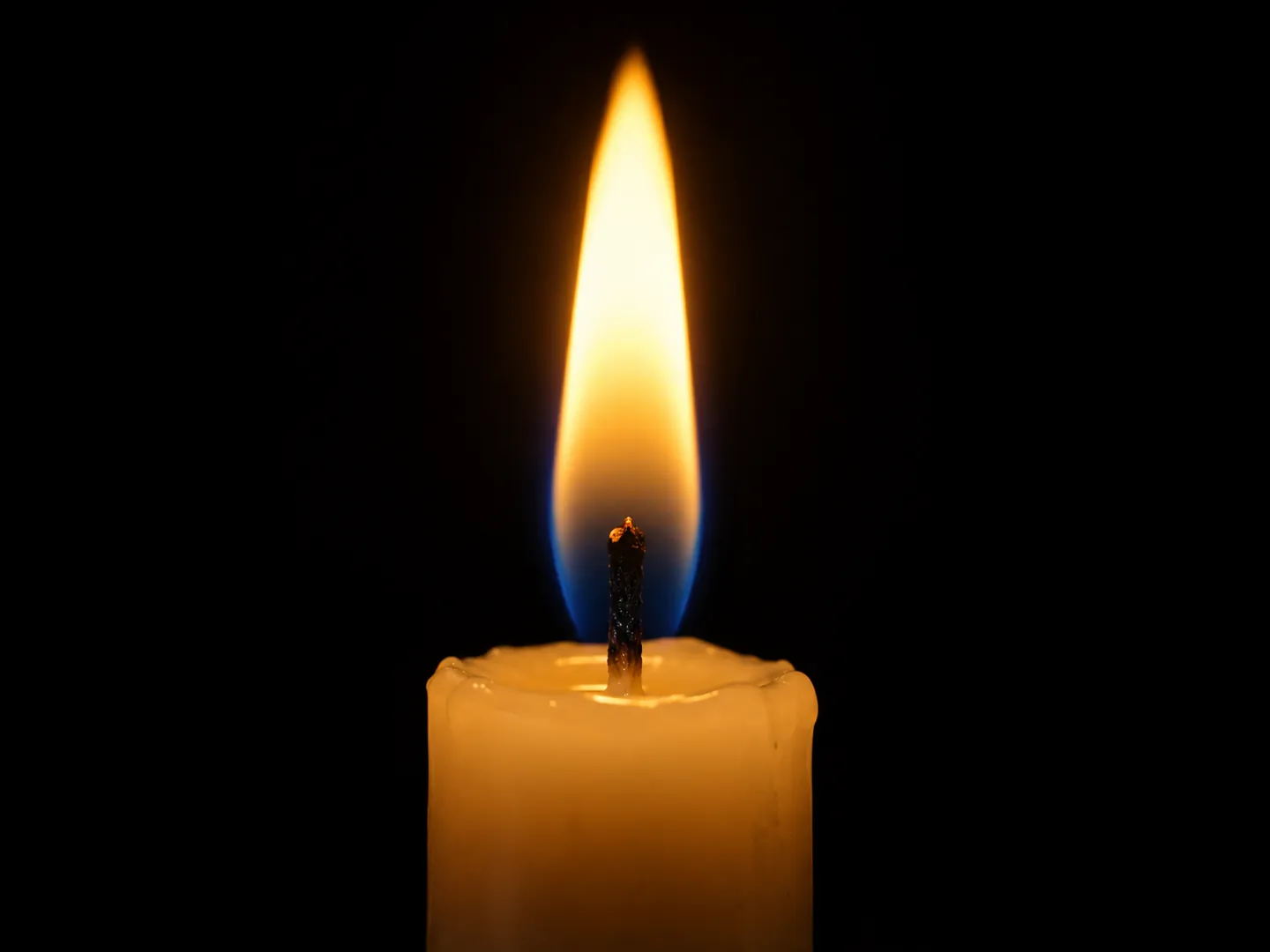
The blue regions are where the burning happens. The yellow comes from tiny soot particles glowing as they are heated.
Explore the zonesSAFETY
Manchester's fire service says candles are one of the top five causes of fire in the home. Never leave one burning unattended.
Safe candle habitsINSIDE THE FLAME
Pick a part of a candle flame to see what is happening there. The bar shows roughly how hot that part runs, from cooler to hottest.
Temperatures are approximate figures from a UK physics teaching site; zones are from a university combustion lecture.
TWO NUMBERS WORTH KNOWING
The flame is hollow in the middle.
The heat lives in a thin outer shell.
≈ 1,400°C
Outer part of a candle flame
A UK physics teaching site gives the outer part of a candle flame as about 1,400 °C, where wax vapour meets the oxygen in the air.
OUTER EDGE · SCHOOLPHYSICS
≈ 800°C
Centre of the same flame
The centre runs at about 800 °C. A paper test described by the Royal Society of Chemistry leaves a scorched ring, showing the flame is hollow.
CENTRE · SCHOOLPHYSICS
In microgravity, NASA explains, there is no buoyant convection to draw the flame up or carry soot to the tip, so a candle flame becomes spherical, soot-free and blue.
FOUR THINGS FARADAY SHOWED
Faraday's lectures, described by the Royal Society of Chemistry, used simple observations anyone can make. Watch with an adult present, on a heat-resistant surface, and keep hair and sleeves clear.
Below the flame, a small pool of melted wax forms. Faraday explained the fuel rises from it up the wick by capillary attraction.
Look for blue near the base and sides, a dark centre and the bright yellow zone that gives most of the light.
On Earth, rising hot air pulls the flame into a teardrop. NASA's images of flames in orbit show round, blue flames instead.
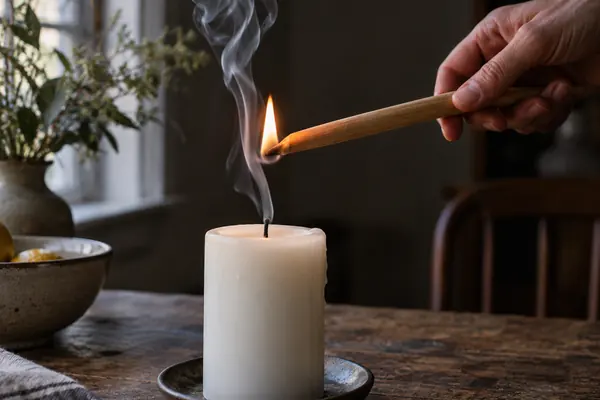
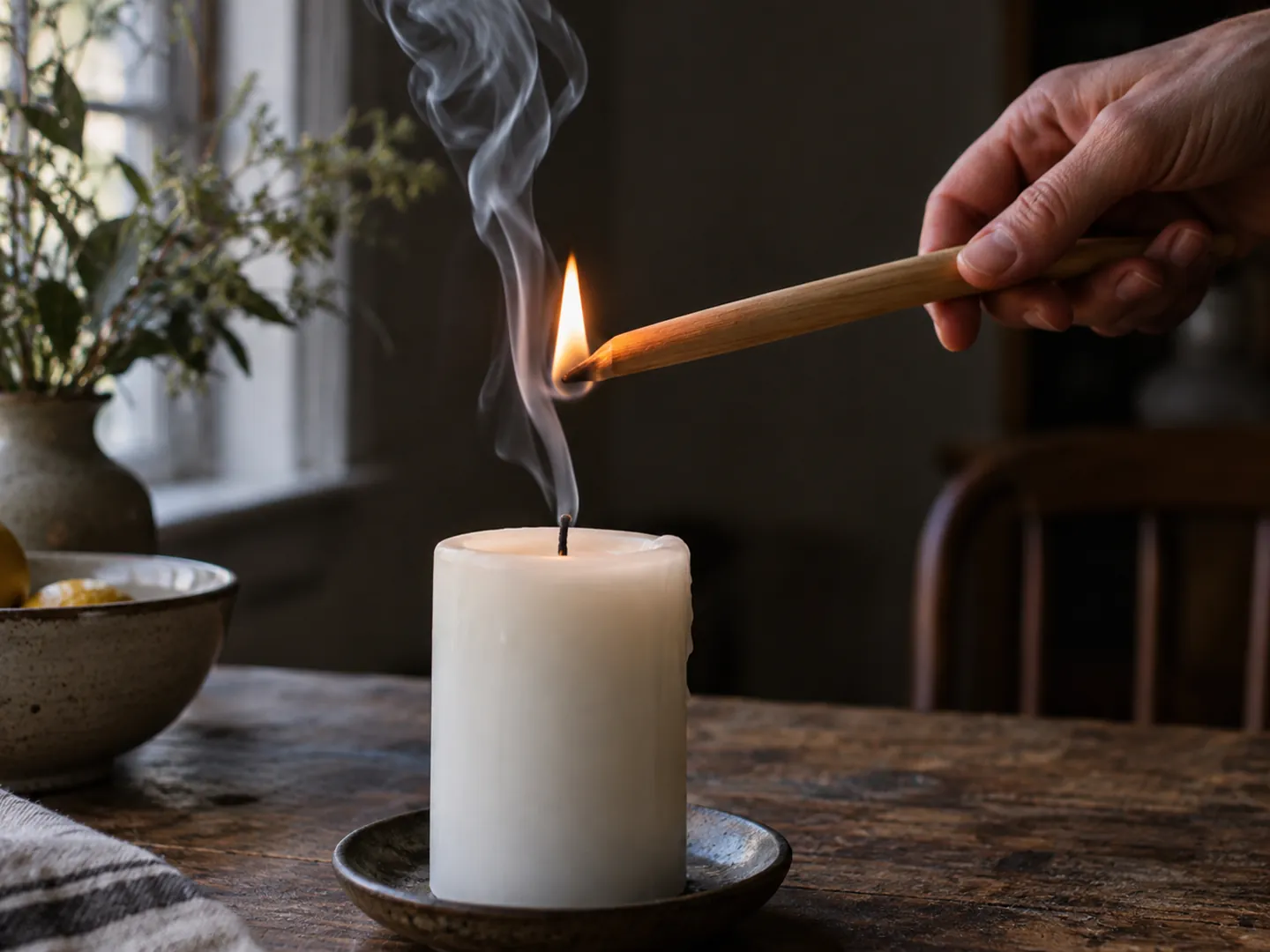
After blowing a candle out, the smoke trail is wax vapour. In Faraday's demonstration a lit taper relights the wick through it.
CANDLES AT HOME
Greater Manchester Fire and Rescue Service advises putting candles in sturdy holders on a flat, heat-resistant surface, leaving at least 10 cm between two lit candles, and never placing them under shelves or near curtains.
Never leave a burning candle unattended, do not move one while it is lit, and put candles out before leaving the room or going to sleep. Battery LED candles give a similar look without a flame, and working smoke alarms on every level are essential.
Questions
Wax vapour. Heat from the flame melts the wax, capillary action draws it up the wick, and it evaporates there. The Royal Society of Chemistry puts it simply: what is burned is a gas.
Carbon from the broken-down wax forms tiny soot particles, and these glow as they are heated. Faraday said the flame owes its brilliancy to these solid particles.
The outer part, where the wax vapour meets oxygen. A UK physics teaching site gives about 1,400 °C there and about 800 °C in the centre. Faraday found the heat lies in a ring.
On Earth, hot gases rise and draw in fresh air, giving a teardrop shape. NASA explains that in microgravity there is no such flow, so the flame becomes round and blue.
Greater Manchester Fire and Rescue Service advises at least 10 cm (four inches) between two lit candles, on a heat-resistant surface, away from curtains and never under shelves.
ABOUT THIS NAME
doodleflame.com is part of the DoodleSale portfolio. It isn't in an auction right now, but you can ask about leasing it.